Rash Festival Photography in Bangladesh is going to be such an exotic and rooted experience, more than you can imagine!
Rash Festival is one of Bangladesh’s most visually captivating cultural celebrations. For photographers, it offers far more than colorful festival scenes. Traditional dance, elaborate clothing, devotional performances, handmade crafts, music, crowds, village life, and intimate moments of preparation all come together to create a rich photographic experience.
If you are visiting Bangladesh and want to experience the country beyond its well-known landmarks, Rash Festival can offer a very different perspective.
However, one important point is worth knowing before planning your trip: the most distinctive Rash Festival photography opportunities are not concentrated in Dhaka. The best-known celebrations include the Manipuri Raash Festival in Moulvibazar, particularly around Madhabpur and Adampur in Komalganj, and the Dubla Rash Mela in the Sundarbans.
For international travelers interested in cultural and documentary photography, these celebrations provide an opportunity to photograph Bangladesh through its people, traditions, performances, and everyday life.
What Is Rash Festival?
Rash Festival, also known as Raash Leela or Rash Purnima, is a Hindu religious and cultural celebration associated with the divine relationship between Lord Krishna and Radha.
In Bangladesh, one of the most important celebrations takes place within the Manipuri community of the Greater Sylhet region. Bangladesh Tourism Board describes Sri Sri Moharaashleela as the principal religious festival of the Manipuri community and notes that it has been celebrated since 1769. The celebrations in Madhabpur and Adampur under Komalganj Upazila are particularly significant.
The festival takes place around the full moon of the Bengali month of Kartik, according to the Hindu lunar calendar. The exact Gregorian date therefore changes from year to year.
For photographers, the festival combines staged performance with genuine community life. You may see traditional dances, devotional music, decorated pavilions, performers preparing for the evening, children participating in celebrations, handicrafts, and large gatherings of visitors.
Where Is the Best Rash Festival Photography in Bangladesh?
There are two very different Rash Festival experiences worth considering.
1. Manipuri Rash Festival in Moulvibazar
For cultural and portrait photography, the Manipuri Raash Festival is arguably the most interesting option.
The main celebrations are held around Madhabpur and Adampur in Komalganj Upazila, Moulvibazar, with connections to Manipuri communities in the wider Sylhet region. Bangladesh Tourism Board specifically highlights these rural celebrations as particularly grand.
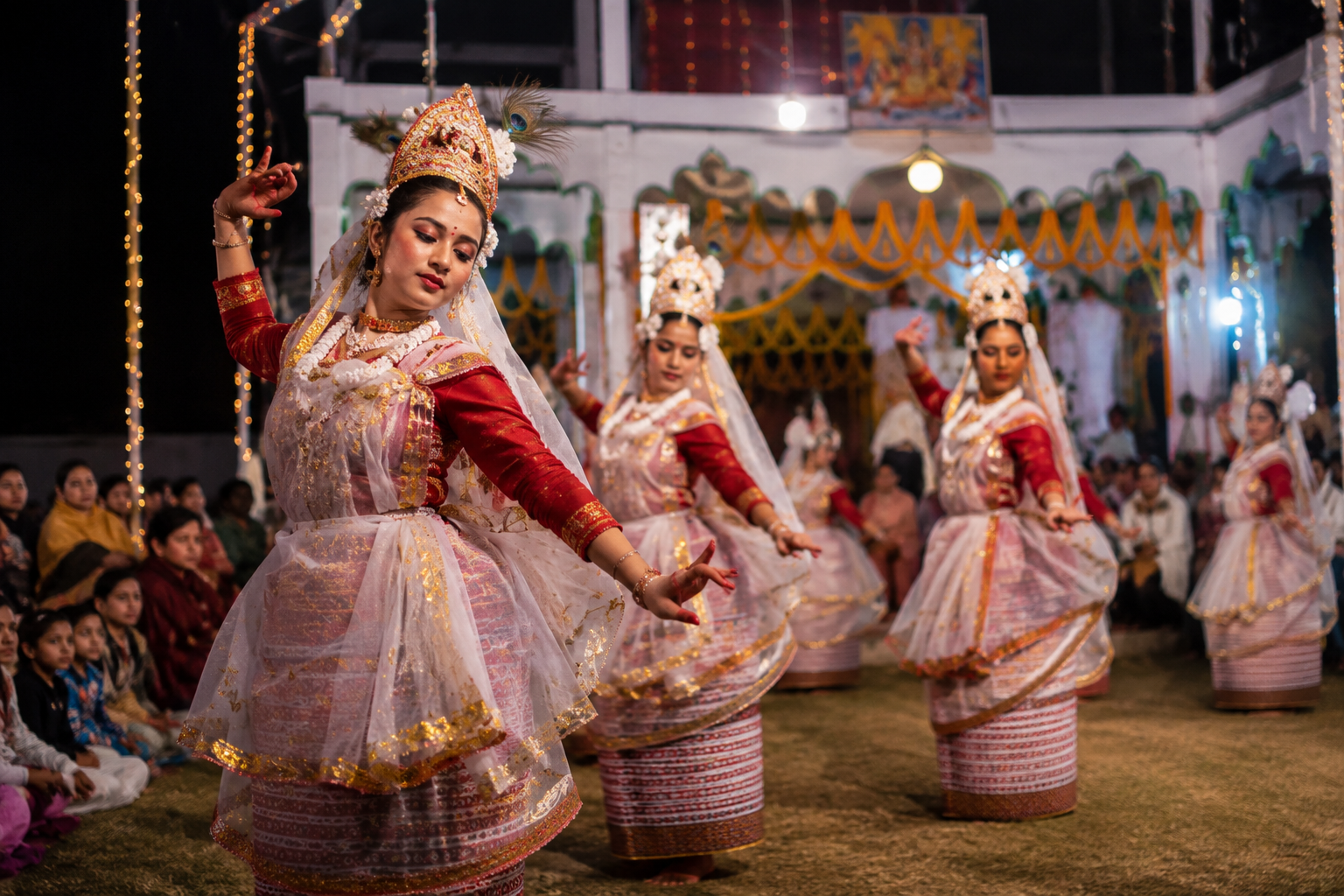
The festival features traditional performances portraying stories associated with Krishna and Radha. Colorful costumes, decorated performance spaces, dancers, musicians, and nighttime celebrations create plenty of opportunities for photographers.
Some photography-focused tours also arrange visits to Manipuri villages and allow travelers to photograph preparations before the main festival.
This is the better choice if your goal is:
- Cultural photography
- Portrait photography
- Traditional dance photography
- Documentary photography
- Village and lifestyle photography
- Night photography
- Photographing traditional clothing and crafts
2. Dubla Rash Mela in the Sundarbans
The second major experience is very different.
Dubla Rash Mela takes place at Dubla Char in the Sundarbans, near the Bay of Bengal. According to Bangladesh Tourism Board, the fair traditionally continues for several days around the full moon in the Bengali month of Agrahayan. The event is closely connected with the fishing communities who work on Dubla and nearby islands.
This creates a completely different photographic environment.
Instead of focusing mainly on dance and performance, photographers can document:
- Fishermen and fishing communities
- Temporary settlements
- Boats and waterways
- The coastal landscape
- Religious ceremonies
- Festival crowds
- Local markets
- Handicrafts
- Life around the Sundarbans
The Bangladesh Tourism Board notes that the event attracts visitors from Bangladesh and abroad and can draw tens of thousands of participants.
For photographers interested in documentary storytelling, Dubla Rash Mela can therefore be especially compelling.
Can You Photograph Rash Festival in Dhaka?
If you are specifically searching for Rash Festival photography in Dhaka, it is important not to assume that Dhaka is the primary destination for the country’s most significant Rash celebrations.
Dhaka can be a useful starting point for your journey, but the strongest dedicated Rash Festival photography experiences are associated with other parts of Bangladesh.
From Dhaka, travelers can plan onward journeys toward Moulvibazar and Sreemangal for the Manipuri celebration. The Bangladesh Tourism Board notes that Moulvibazar can be reached by train via Sreemangal, followed by road transport toward Komalganj and the festival areas.
This makes it possible to combine a Dhaka stay with a cultural photography trip into northeastern Bangladesh.
What Can You Photograph at Rash Festival?
One of the biggest advantages of photographing Rash Festival is the variety of subjects.
You do not need to spend the entire event photographing the main performance.
Traditional Dance
The Manipuri celebration is particularly known for its dance performances.
The Raash Leela tells stories associated with Krishna and Radha, with performers appearing in traditional costumes and participating in choreographed devotional performances.
Try photographing more than just full-body stage shots.
Look for:
- Hand gestures
- Facial expressions
- Footwork
- Costume details
- Musicians
- Interaction between performers
- Moments immediately before and after performances
A longer lens can help you capture these details without standing directly beside the performers.
Traditional Clothing
Costumes are among the most visually distinctive elements of the festival.
Rather than photographing only complete outfits, look for details such as fabric, jewelry, headwear, embroidery, and movement.
A close-up of a dancer preparing backstage can sometimes tell a stronger story than a conventional performance photograph.
Festival Preparations
Some of the best photographs may happen before the festival officially begins.
Participants prepare costumes, decorate spaces, organize performances, gather with family members, and get ready for the night’s celebrations.
Photography-focused travel experiences around the Manipuri festival specifically highlight these preparations as opportunities for cultural photography.
If you are interested in documentary photography, arrive early rather than only attending the main performance.
People and Portraits
Rash Festival brings together performers, families, devotees, craftspeople, musicians, visitors, and children.
These people can become the heart of your photo story.
But remember that a good cultural portrait begins with respect.
If you want to make a close-up portrait of someone, ask permission whenever appropriate. A simple smile, gesture, or polite question can often make the interaction more comfortable.
Avoid treating people simply as photographic subjects. Take time to observe the environment around them.
Handicrafts and Local Markets
Festival markets provide another layer to your photography story.
At the Manipuri celebration, you may find traditional handicrafts and locally made products. The Dubla Rash Mela also features handicrafts and wooden items, according to Bangladesh Tourism Board.
Instead of photographing an entire market from a distance, look for small visual stories:
A craftsperson working.
A customer choosing an item.
Hands exchanging money.
Rows of handmade products.
Children looking at toys.
These small moments can help turn a collection of festival photographs into a narrative.
Best Camera Gear for Rash Festival Photography
You do not need an expensive professional camera to photograph Rash Festival.
A mirrorless or DSLR camera with a versatile lens is more than enough.
A practical setup could include:
24–70mm or similar zoom:
Useful for environmental portraits, crowds, market scenes, and general festival photography.
70–200mm or similar telephoto:
Useful for performances and portraits when you need to keep some distance.
35mm or 50mm prime lens:
Excellent for natural-looking portraits and documentary-style photographs.
Fast lens:
Particularly useful for evening and nighttime performances.
Extra batteries:
Festival days can be long, and charging facilities may not always be convenient.
Extra memory cards:
Continuous shooting during dance performances can fill a card quickly.
You may also want a lightweight camera bag rather than a large backpack, especially when moving through crowded festival areas.
Photography Settings for the Night Festival
The Manipuri Raash Festival can involve extended evening and nighttime performances, so low-light photography deserves some preparation.
Start with a relatively wide aperture, such as f/2.8 or wider, if your lens allows it.
Increase ISO when necessary rather than relying on extremely slow shutter speeds.
For moving dancers, a shutter speed around 1/250 second or faster can help freeze movement, although you may need to adjust depending on the available light.
If the scene is very dark, embrace some motion blur rather than trying to make every photograph perfectly sharp. A small amount of movement can sometimes communicate the energy of a dance performance better than a completely frozen frame.
Shoot in RAW if your camera supports it. This gives you greater flexibility when recovering shadows and adjusting exposure during editing.
Photography Etiquette at Rash Festival
Rash Festival is a religious and cultural celebration, not simply a photography event.
This should influence how you photograph it.
Ask Before Taking Close-Up Portraits
If someone is posing specifically for you, permission is obvious. But when photographing strangers at close range, asking first is the respectful approach.
Be Careful Around Religious Rituals
Do not block worshippers, performers, priests, or other participants simply to get a better photograph.
If photographers are given a designated area, stay within it.
Avoid Using Flash Without Considering the Situation
Flash can distract performers and people participating in religious activities.
Whenever possible, use available light and a fast lens.
Dress Appropriately
Choose comfortable clothing that is also respectful of the religious and cultural setting.
Do Not Interrupt Performances
A photographer moving constantly in front of performers can negatively affect both the audience and the event.
Sometimes the best photograph is the one you capture from a respectful distance.
Best Time to Photograph Rash Festival
The festival follows the lunar calendar, so the date changes every year.
The Manipuri Raash Festival is associated with the full moon of the Bengali month of Kartik.
Dubla Rash Mela is also organized around the full moon period, although Bangladesh Tourism Board describes its timing using the Bengali month of Agrahayan.
Because the dates can change annually, check the festival schedule before booking flights, accommodation, or transportation.
For photographers, arriving at least a day before the main celebration can be worthwhile. It gives you time to explore the surrounding area and photograph preparations rather than arriving immediately before the main event.
How to Reach the Manipuri Rash Festival from Dhaka
For international travelers, Dhaka is likely to be the first major arrival point in Bangladesh.
From Dhaka, you can travel toward Sreemangal and Moulvibazar.
Bangladesh Tourism Board states that Moulvibazar can be reached by train via Sreemangal. From Sreemangal, travelers can continue by road toward Komalganj, including the rural areas around Madhabpur and Adampur where the festival is celebrated.
Sreemangal also makes a useful base for photographers because the surrounding area offers additional subjects, including tea gardens and rural landscapes.
That means your trip does not have to be limited to the festival itself.
You can combine:
Dhaka → Sreemangal → Manipuri villages → Rash Festival → Moulvibazar
with additional photography opportunities along the way.
A Simple Rash Festival Photography Itinerary
If you are traveling from overseas, consider allowing several days rather than making the festival a rushed day trip.
Day 1: Dhaka
Explore Dhaka and photograph everyday urban life, historic neighborhoods, markets, and river scenes.
Day 2: Travel to Sreemangal
Travel toward Sreemangal and explore the surrounding countryside.
Photograph tea gardens, rural landscapes, local markets, and village life.
Day 3: Manipuri Community
Spend time around the Manipuri communities and, where appropriate, photograph preparations, crafts, clothing, and everyday life.
Day 4: Rash Festival
Arrive early.
Photograph the festival environment during the day, then return for the evening and nighttime performances.
Day 5: Return
Travel back toward Dhaka or continue exploring northeastern Bangladesh.
This slower approach gives you a much better chance of creating a photographic story rather than simply collecting a few event photographs.
Tips for International Photographers
If this is your first cultural festival in Bangladesh, a little preparation will make the experience much easier.
Carry Cash
Smaller vendors and local transport providers may not accept international cards.
Keep Your Equipment Compact
Large camera bags can become difficult to manage in busy crowds.
Protect Your Gear
Weather conditions can change, particularly during outdoor events. A simple rain cover or waterproof bag is useful.
Carry Spare Batteries
Do not assume you will have convenient access to charging facilities throughout a long festival day.
Back Up Your Photos
If you are carrying a laptop or portable storage device, back up your photographs each evening.
Hire a Local Guide When Appropriate
A knowledgeable local guide can help you understand where you can photograph, communicate with residents, and navigate rural areas.
For a cultural photography trip, local knowledge can be just as valuable as expensive camera equipment.
Is Rash Festival Worth Visiting for Photographers?
Absolutely — particularly if your interest is cultural or documentary photography.
The strongest reason to visit is not simply that the festival is colorful.
It brings together performance, faith, traditional clothing, music, community life, crafts, and human stories in one environment.
The Manipuri celebration is particularly attractive for photographers because the festival combines traditional dance with village and community life. Bangladesh Tourism Board describes the celebrations around Madhabpur and Adampur as especially significant, while photography-focused tours emphasize the performances, preparations, traditional clothing, and surrounding villages.
Dubla Rash Mela offers a completely different visual story, connecting religious celebration with the lives of fishing communities in the Sundarbans and the coastal environment.
For travelers willing to move beyond Dhaka, both experiences can add something genuinely different to a Bangladesh photography itinerary.
Final Thoughts
Rash Festival offers photographers a chance to see Bangladesh through a cultural lens that is easy to miss on a conventional sightseeing trip.
If you are staying in Dhaka, consider using the capital as the starting point rather than the final destination. Travel toward Moulvibazar and the Manipuri communities for the Raash Festival, or consider the very different experience of Dubla Rash Mela in the Sundarbans.
Bring your camera, but bring patience as well.
The strongest photographs may not come from standing directly in front of the main performance. They may come from a dancer preparing backstage, a musician waiting for the performance to begin, a family sharing a moment at the fair, a craftsperson working at a stall, or a quiet scene after the crowds begin to disappear.
Photograph the festival as a cultural experience, not simply as a colorful event — and your images will tell a much stronger story.
FAQ on Rash Festival Photography in Bangladesh
When is Rash Festival celebrated in Bangladesh?
Rash Festival is celebrated around the full moon according to the Hindu lunar calendar, so the Gregorian date changes each year. The Manipuri Raash Festival is associated with the full moon of the Bengali month of Kartik, while the Dubla Rash Mela takes place around the full moon of Agrahayan.
Where is the best place to photograph Rash Festival in Bangladesh?
For cultural and festival photography, the Manipuri Raash Festival in Moulvibazar, particularly around Madhabpur and Adampur in Komalganj, is one of the most distinctive options. Photographers can capture traditional dance, costumes, music, crafts, and community life.
Can international tourists attend Rash Festival?
Yes. International travelers can attend the festival, but it is important to treat it as a religious and cultural event rather than simply a tourist attraction. Visitors should follow local instructions, dress respectfully, and avoid disrupting ceremonies or performances.
Is Rash Festival held in Dhaka?
Dhaka is not the main destination for Bangladesh’s best-known Rash Festival experiences. Travelers interested in photographing the major celebrations should consider traveling from Dhaka to Moulvibazar for the Manipuri Raash Festival or toward the Sundarbans for the Dubla Rash Mela.
Can I take photographs during Rash Festival?
Photography is generally possible, but visitors should be respectful. Ask permission before taking close-up portraits, avoid obstructing performances or religious activities, and be cautious about using flash during nighttime ceremonies.
What camera is best for Rash Festival photography?
A mirrorless or DSLR camera with a versatile zoom lens is ideal, although a good smartphone can also produce excellent photographs. For nighttime performances, a fast lens and good high-ISO performance are particularly useful.
What should I photograph at Rash Festival?
Look beyond the main performance. Traditional dance, costumes, musicians, festival decorations, handicrafts, preparations, portraits, markets, crowds, and everyday interactions can all become part of a strong photographic story.
Is Rash Festival worth visiting for photographers?
Yes. The combination of traditional performance, colorful clothing, religious traditions, community life, and local craftsmanship makes Rash Festival particularly interesting for cultural and documentary photographers. The Manipuri celebration around Moulvibazar is especially worth considering for travelers who want to combine festival photography with rural Bangladesh.